
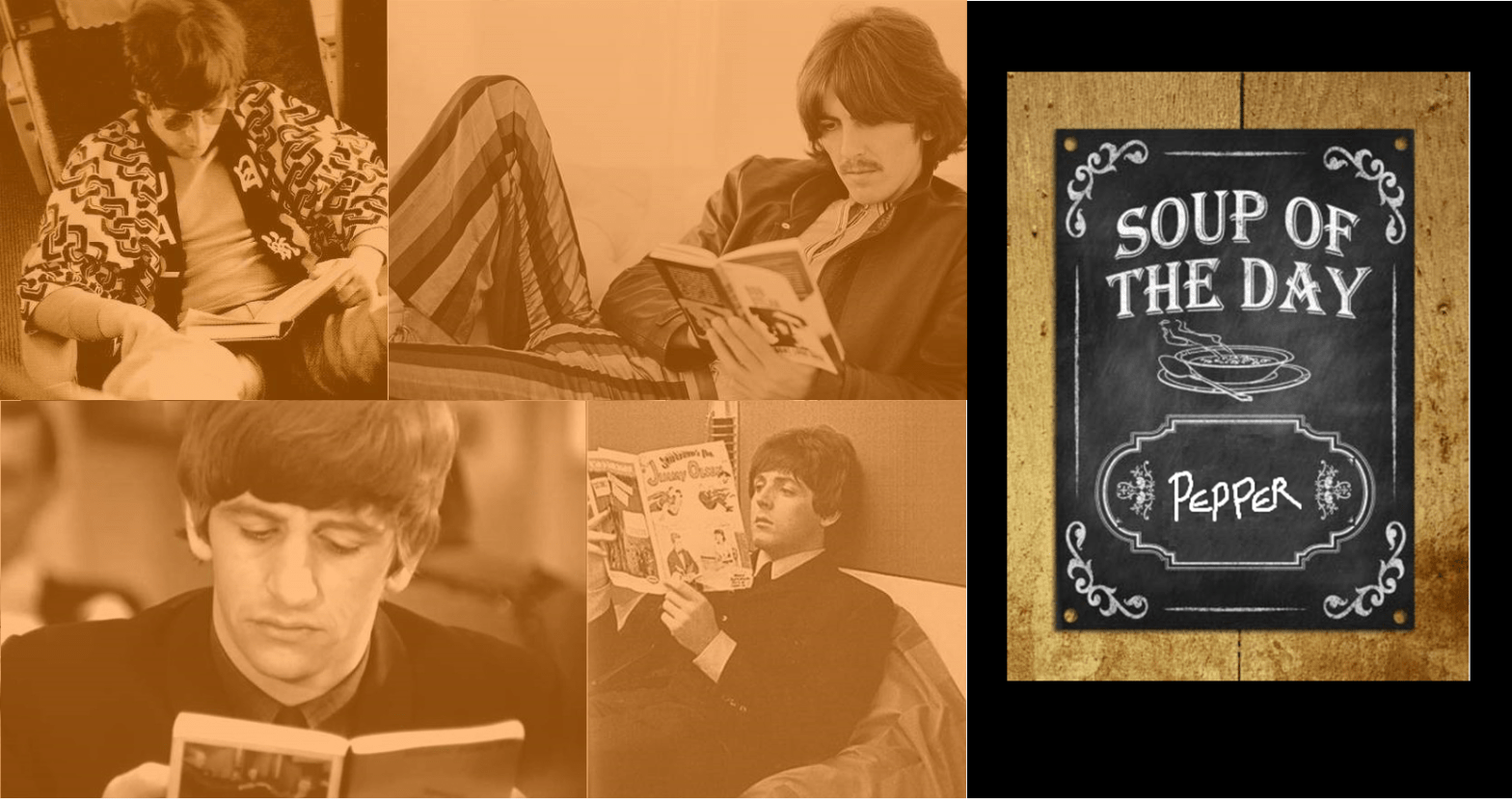
This piece of speculative fiction addresses the question, “What if John Lennon hadn’t gone to Spain with Brian Epstein in 1963, and stayed home with his wife and newborn son instead?” In this story, set in the spring of 1967, the Fab Four are still in Liverpool, working at remarkably un-fabulous jobs. But Paul arranges a gig for the group that might propel them to stardom at last.
* * * * *
“Oh. It’s you.”
John opened the restaurant’s back door a little wider to accommodate his visitor’s large tool kit, and gestured for the electrician to step into the kitchen.
“Lovely to see you again too, mate,” George replied indifferently. “So where’s the wonky widget?”
“This way,” said John. He closed the door and led his old friend to the industrial stove in the far corner of the room. “The back two burners stopped working yesterday. It was bloody hell trying to keep the sauces warm all evening. Thank God it was only a Tuesday and we weren’t very busy.”
George pulled a flashlight and screwdriver out of his toolbox and started disassembling the back of the stovetop. “Didn’t I just fix this last month?”
“Could have fooled me,” John remarked. He lit a cigarette and stepped away from the stove so he could chop onions while his friend worked.
“Fuck,” George muttered under his breath. “The wires are fused.”
“That’s what you said last time,” John replied. “Wanna fag?”
George stepped away from the stove and accepted the cigarette and lighter John offered him. He lit the tip and inhaled deeply, then released his breath in a long stream of pale smoke. “Your boss doesn’t mind you smoking all over the ingredients?” he asked before sucking in another long drag.
“He knows better than to try and stop me,” John said. He picked up a larger knife and mimed slicing his throat, then returned to chopping his onions.
George reached into his toolbox, his cigarette dangling from his lips, and pulled out some pliers and clippers. “You heard from our Paul?” he mumbled through his half-closed mouth.
John snorted. “About his job, or the job he wants us to bloody do?”
George rested his cigarette on the chipped saucer where John had laid his and pointed his flashlight at the fused wires. “Either. Both,” he answered distractedly. “I hadn’t realized he had a solo gig lined up as well.”
“He doesn’t,” John replied. He snatched another puff on his cigarette, then scraped his chopped onions into a glass bowl and lay a couple of damp leeks on his cutting board. “I meant his real job. He told me he had an interview set up this afternoon after school gets out. He’s applied for a position teaching third form at my old school.”
“The Quarryman returns to the scene of the crime!” George laughed. “Christ, do you s’pose your old headmaster might actually hire him?”
“Dunno,” John said with a shrug. “Paul can’t be any worse than the dopes who taught me English when I went there.” He sliced through the bottom of his leeks, removing the fine hairs, then chopped the large leaves off the top of the bulbs. “And it’d be good to take the poor sod out of temptation’s way. I knew he’d get in trouble teaching at that girl’s school on Blackburne Place. The last thing our Paulie needs is a classful of teenage bints gazing up at him all day long.”
“He never was very good at resisting temptation,” George agreed. “I’m gonna turn off the switch that feeds your Aga for a second so I can cut through this mess.”
“Suit yourself,” John said. He sliced his leeks into half-moons, then scraped them into another bowl on the countertop.
When George returned from the fuse box, he picked up his smoldering cigarette and took another deep drag. “You gonna save the tops of those leeks? They’d make a nice veggie stock, y’know.”
“Just ’cause you’re a vegetarian now, that doesn’t mean you can tell me how to cook! I’ve been working in this bloody restaurant longer than you’ve had your electrician’s license.”
George rolled his eyes and sucked on his cigarette again. “So tell me what Paul’s got up his other sleeve. I know he talks to you more about his wild musical fancies than he does me.”
John wiped his brow with his forearm and rinsed a colander full of button-top mushrooms in the large, industrial-sized sink, then returned to his cutting station. “His dad’s jazz combo is taking the summer off, so Paul signed us up for one of the vacant Friday slots in their usual club at Birkenhead. He booked us to play a gig about six weeks from now, so we’ll have time to write some new material. He wants to present a concert of all new songs.”
“Bugger me, he wants us to work our arses off writing a bunch of new tunes so we can debut them for a crowd of coffin-dodgers who wouldn’t know a Buddy Holly song from a Chuck Berry record?” George scoffed.
John shrugged. “Paul says he’s been talking to Brian. Seems like they’ve mended their fences, and our old manager might just invite a handful of record executives to watch our performance that night.” He started trimming the mushrooms one-by-one and placing them in a third bowl on the countertop.
“Well how about you and Brian?” George challenged. “Have you mended the giant, fuckin’ wall that’s been standing between the two of you these last four years?”
John concentrated on his task at hand and refused to make eye contact with George. “Aren’t you supposed to be fixing that bloody Aga?”
George sucked in the last of his cigarette and crushed out the stub in the saucer, then returned his attention to the appliance. The two men worked in silence for several minutes. A loud, incessant knocking on the back door shattered their peace.
“I’ll go see who that is,” John said in a high-pitched falsetto. He lifted the bottom corners of his stained apron with his hands and skipped to the door. “The milkman sometimes comes to see me this time of day when he’s done with his rounds.”
“I got the job!” Paul yelled as soon as John opened the door.
“Good on you,” John replied with a smile. “I’m chuffed to hear it.”
“You start right away, or in the fall?” George called over his shoulder as he continued dinking with the wires.
“I’m gonna fill in for an ailing teacher for the rest of this school year,” Paul called back to him. “But the headmaster said if he likes me, he’ll take me on staff in for the Michaelmas term.”
“What’s not to like?” John laughed. “You’re a natural born entertainer. You’ll hold your classes’ attention from the moment you start speaking.”
“But will you actually teach them anything?” George challenged.
Paul shrugged. “Who remembers anything they learned in high school after they leave?” He followed John over to the cutting station. “Whatcha cooking?”
“Soup,” John replied. He sucked one last drag out of his stubby cigarette and crushed it out beside the butt George had left. “Tell George your grand plans for the jazz club. I mentioned that you wanted us to write a dozen new songs, and he said you were daft.”
Paul turned towards George. “Well, John and I can take care of the songwriting duties, if you don’t feel up to the task.”
“Speak for yourself,” John grumbled. “I’m too busy to write anything new.”
“And I sure as hell don’t fancy performing twelve new Paul McCartney songs for a crowd of grey-hairs in a jazz club,” George groused.
“Listen up,” Paul said, folding his arms in front of his chest and attempting an authoritative pose. “This isn’t just going to be a concert. This is going to be a happening. I’ve got this fantastic idea. Since we’ll be playing a traditional club, we’ll wear traditional costumes, but with a tweak. The art teacher at the last school I subbed at made me this fabulous electric blue satin military coat, decorated with medals, cords and epaulets. It’s a real send up to the establishment. And she said she can sew matching coats for you lot, so we’ll present a unified front. We’ll be the groovy grenadiers.”
John and George exchanged dubious glances. Then John cleared his throat. “I don’t look good in blue.”
“Then she’ll make you a bright green coat,” Paul replied. “And George can wear orange.”
“I hate orange,” George said with a scowl.
“Better make it tangerine,” John suggested, turning towards Paul. “It’s a very trendy fruit.”
“What’s the bloody difference?” George asked.
John shrugged. “It’s too subtle to explain. You’d have to be in the restaurant business to understand. What color coat should Ritchie wear?”
“I dunno, something bright,” Paul replied. “Maybe pink?”
“Oh, he’s gonna love that,” George interjected, his voice dripping with sarcasm.
“We’ll call it raspberry, to go with your tangerine coat and my lime green jacket,” John laughed. “Then after Paul’s done playing his twelve new songs for Brian and company, the three of us can lead the codgers and crones in a raucous rendition of ‘Tutti Frutti’. They can stomp their canes to the beat.”
George sniggered.
Paul rolled his eyes, but continued with his plea. “Now here’s my plan for the songs. Since we’re gonna be dressed like a military band, and playing for a bunch of old widows and widowers, I thought we could present ourselves as a Lonely Hearts Club Band.”
“What? We’re not gonna bill ourselves as the Beatles?” John asked, cocking a bushy eyebrow over the frames of his thick black glasses.
“We will, but we’ll be ‘The Beatles Lonely Hearts Club Band’ for the night,” Paul explained.
“This is even barmier than I thought it would be,” George mumbled. He turned his back on his old bandmates and resumed his rewiring work.
“I’ve written a little tune we can use to open and close the show,” Paul said, stepping closer to John. “We’ll play the entire song at the beginning, then repeat a single verse at the end when we’re done singing our other new songs. It’ll work like a pair of bookends.”
“Right,” John said unenthusiastically. He reached for his pepper mill and started grinding it over his bowl of trimmed mushrooms.
George sneezed. “Bullocks! How much pepper are you putting on those poor little ’shrooms?”
“I like pepper,” John replied, spinning his mill with a grand flourish. “After I don this fancy dress uniform Paul’s bird is gonna sew me, you can start calling me ‘Private First Class Pepper’.”
George sneezed again. “Commodore Pepper might be more like it. Or even Admiral Pepper.”
“Fuck the military hierarchy!” John shouted, raising the middle fingers of his hands in a rude salute. “I aim no higher than the rank of Sergeant-at-Arms!”
“Sergeant Pepper!” Paul exclaimed. “That’s perfect! It’ll fit the meter of that bookend song I was just talking about. ‘Sergeant Pepper’s Lonely Heart’s Club Band!’”
John rolled his eyes, then threw a sharp glance at George. “You almost done? I wanna start boiling my stock.”
Paul frowned. “Neither of you seems terribly excited about this show. Don’t you see? This could be our big break at last. Brian said he’d bring along some of his friends from EMI to hear us perform.”
“Brian hates me,” John replied, lowering his voice to a husky whisper. He stirred the pepper into his mushrooms with a wooden spoon and reached for his salt shaker. “He’ll probably be a no-show, just to even his score with me.”
“Brian doesn’t hate you,” Paul insisted. He waited for John to raise his head, then looked his old friend squarely in the eye. “He understands why you left him at the airport that day and went back to Cyn. I’m sure that in his heart, he knows you did the right thing – that it was more important for you to be with your wife and newborn son that week, and not just dart off to Spain to soak up some sun with him.”
John offered no reply and started pulling jars of spices off the rack behind the counter.
“I just wish you would have told me you were gonna pull that stunt,” Paul added quietly. “Then I could have gone with Brian instead, and he wouldn’t have offered your ticket to Gerry Fuckin’ Marsden.”
“What’s done is done,” George called out from his corner of the kitchen. “It doesn’t matter anymore. Why waste time worrying about people who gain the world but lose their soul?”
“You think Marsden’s become a soulless zombie now, do ya?” John asked, his smile returning. He stretched out his arms in front of him and rolled his eyes behind their lids, then started intoning Ferry Cross the Mersey in a dead-sounding monotone while he staggered towards George. He grabbed his large stock pot off the far corner of the stovetop and returned with it to his cutting station.
“Gerry hasn’t lost his soul,” Paul said. “I spoke with him not long ago. He’s still riding high on his success.”
George rested his tools on the stovetop and turned towards Paul. “So why did the Pacemakers stop touring then?” he countered. “I’ll tell you why. The rest of his band was tired of performing for stadiums full of screaming fans who don’t even appreciate their music anymore. Brian’s turned Gerry’s group into a crass, commercial conglomerate. I was talking with Les Chadwick not long ago. He told me Gerry’s grown paranoid ever since his bandmates refused to hit the road with him anymore. All he thinks about now is scoring another number one single.”
Paul sighed. “But just think – if John hadn’t walked out on Brian that day, things might have turned out very differently. We could have been the first British group to score a number one hit in America. The world could have been under the thrall of Beatlemania these past four years, instead of Marsden Mania.”
“Yeah, right,” John said. “It’s all my fault. Rub it in again, please, why don’t you, Paulie? My salt shaker’s right over there by the onions.”
“I didn’t mean it like that,” Paul apologized. “I respect your decision. I don’t blame you for wanting to do right by your son, after the way your parents deserted you.”
John raised his hands in irritation. “Enough already. Let’s talk about your goddamned show again and leave off all this soft shit.”
“Right,” Paul agreed. He cleared his throat and leaned against the counter that stood between John and George. “So I’m thinking we’ll play twelve new songs. Thirteen, if you count that opening tune which we’ll do twice. I’ve written two songs already – Getting Better and Fixing a Hole. They both have a really positive vibe. And I thought I’d play that old dance hall number I wrote for my dad all those years ago. You know – the one we used to perform at the Cavern whenever our amps broke down. I’ll ask a few of Dad’s bandmates to join me on clarinet and horn. Dad’s turning sixty-four this year, so it seems appropriate. I’m also working on a tune about this girl named Rita I just met.”
“Is she the art teacher who’s sewing my tangerine-colored costume?” George asked as he twisted his newly spliced wires together.
“No, she’s a meter maid,” Paul replied. “I caught her leaving a ticket on my car and tried to talk her into tearing it up. She only agreed to do that if I’d take her out to dinner. So I’m bringing her here this weekend. Thought she might fancy some of John’s pepper soup.”
“My boss said he’s not gonna give you any more discounts,” John groused as he dumped his leeks and onions into the large stock pot. “He claims you’re taking advantage of his hospitality.”
“Well, if this concert is the success I think it’ll be, we needn’t worry about discounts anymore,” Paul boasted. “We can quit our day jobs and become full-time professional musicians at last.”
“I actually work a lot of nights at this job,” John noted.
Paul sighed again. “So, writing partner, have you been working on any new tunes like I asked you to?”
“I’m fuckin’ busy!” John cursed. “I’m with the boy all morning while Cyn works on her commissions, then I’m here at the bloody restaurant all afternoon and evening. ’Cept for Mondays when we’re closed.”
“Well, at least you can watch Meet the Wife on the telly then,” George called over his shoulder.
“Right, maybe I’ll write a song about having tea with Cyn and watching Meet the Wife,” John proposed.
“She bringing in much cash with her illustrations?” George asked.
“She’s doing all right,” John said. “Ritchie and Mo just paid her a tidy sum to make some adverts for their newest hairdressing shop in Norris Green.”
“Lovely. I just did the wiring for the hairdryers there,” George replied.
Paul rolled his eyes. “You must have something else going on in your life that could inspire a song or two, John, besides watching shows on the telly. How’s the boy been?”
“Julian’s fine,” John said, turning his gaze back towards Paul. “He made friends with a little girl named Lucy at his nursery school. He colored a picture of her the other day, dancing in a sky full of diamonds.”
“Well, maybe you can do something with that,” Paul suggested feebly. “Anything else?”
John tapped his fingers against his cutting board as he jogged his memory. “We took Julian to a circus on Easter. And he liked it so much, Cyn bought a bunch of circus crap at a charity shop to decorate his room with. I just framed a moldering poster advertising Pablo Fanque’s Circus Royal to hang on his wall. It’s a tad verbose, but maybe I can set the poster’s lines to music.”
Paul’s shoulders slumped. “Great. Or maybe something else?”
“Like what?” John replied.
“Bugger, I don’t know,” Paul cursed. “Write something contemporary. I know you’re always reading the newspaper. Write about the war in Vietnam. Or the crisis in Biafra.”
“Or the holes in the Lancashire roadways,” John countered. “I saw a piece in The Echo the other day that said there were four bloody thousand of them in Blackburn alone.”
“Christ, you mean somebody actually counted them all?” George said, looking up from the stove.
“Civil servants need something to do,” John replied with a shrug.
“Okay, okay,” Paul said. “Just see what you can do. George, you working on any new songs?”
George rested his pliers on the stovetop and focused a steely gaze at Paul. “Oh, yes, honored wise one! Thank you for looking down upon me in my lowliness. I have indeed penned a new tune for you to consider for your magnum opus.”
Paul scowled.
John laughed. “Right, what’ya got, Harrisong?”
George turned to face John. “I’m working on a song based on some Vedic scripture I’ve been studying. There’s this bloke at work named Aditya whose been teaching me how to play the sitar. He and his brothers are very musical. And very spiritual. He’s really opened my eyes to a whole new world.”
John carried his stockpot to the sink and started filling it with water. “Forgive me for asking.”
“No, I think that’s actually a very good idea,” Paul said, offering George a wan smile. “I’ve heard Gerry Marsden is going off on some big Indian kick these days. Brian told me he’s dragging the Pacemakers to a seminar in Wales this summer so they can sit at the feet of some hair-brained maharishi. But if we include an Indian song in our concert, we can beat them to the punch. We’ll show those record executives that we’ve got our fingers on the pulse of the times.”
“Well, squeeze George’s sitar solo in next to that dance hall dittty you wrote for your dad, so I can step outside and have a long smoke in the middle of the concert,” John suggested. “You done with that bloody Aga yet, George?”
“Let’s give it a go,” George said. He walked to the fuse box and pulled the circuit breaker just as the kitchen’s front door opened with a loud squeak. A flash of flame erupted from the stovetop. The overhead lights flickered and the kitchen went black.
“Bloody hell,” George swore into the darkness.
John fumbled towards the squeaky door to let in some light from the restaurant’s dining area and bumped into a large mass. “Bullocks!” he cursed. “What did I just put my grubby fingers on?”
“I can’t tell you, but I know it’s mine,” Ringo replied.
“Ritchie!” John and Paul exclaimed in unison.
George shone his flashlight at his old drummer’s face, and then pointed it back at the fuse box. He started opening and closing random circuits. The lights flickered back on.
“Mr. Harrison!” Ringo called across the room. “You’re the very person I was looking for. That hair dryer you fixed in my shop last week just blew up.”
“Get in line,” John said. “I called him here first.”
“I’ll get to it,” George mumbled under his breath as he shone his flashlight back at the charred stovetop.
“Meanwhile, let Paulie tell you about the gig he’s got lined up for us,” John suggested.
Paul smiled and repeated a quick run-through of his plans.
Ringo put his hand to his face and rubbed his chin thoughtfully. “I see. And will this high-concept concert of yours include a little Starr Time for me?”
“Sure,” Paul blustered. “John and I are working on a song for you right now.”
John sniggered. “Yeah, what are friends for?”
“And Paulie’s new bird is going to sew us a set of psychedelic soldier costumes,” George called over his shoulder as he dug back into his tool box. “Your’s is gonna be pink.”
“So what do you think, Ritchie, are you in?” Paul asked, his previously confident voice betraying a hint of nervousness.
Ringo rubbed his chin once more and threw a glance at the calendar hanging by the fuse box. “You say we’ve got six weeks to prepare?”
Paul nodded.
“Right,” Ringo said, lowering his hands to the pockets of his jacket and smiling. “That should be enough time for you and John to grow mustaches to match George’s and mine. Brian always wants us to present a unified front.”
 Creme Tangerine